Bingliang Zhang
I am a Ph.D. student at Caltech in the CMS department. I am advised by Yisong Yue and have worked with Yang Song. My research focuses on efficient pre-training and inference time algorithms for generation, which I have applied to real-world tasks like personalized generation and scientific inverse problems.
I earned my B.S. in Computer Science from the Yao Class at Tsinghua University, where I had the privilege of working with Yi Wu and Yang Gao. Before my Ph.D., I visited Carnegie Mellon University, where I worked with Jun-Yan Zhu, Eli Shechtman, and Richard Zhang on controllable diffusion models.

Selected Publications
All publications- CVPR
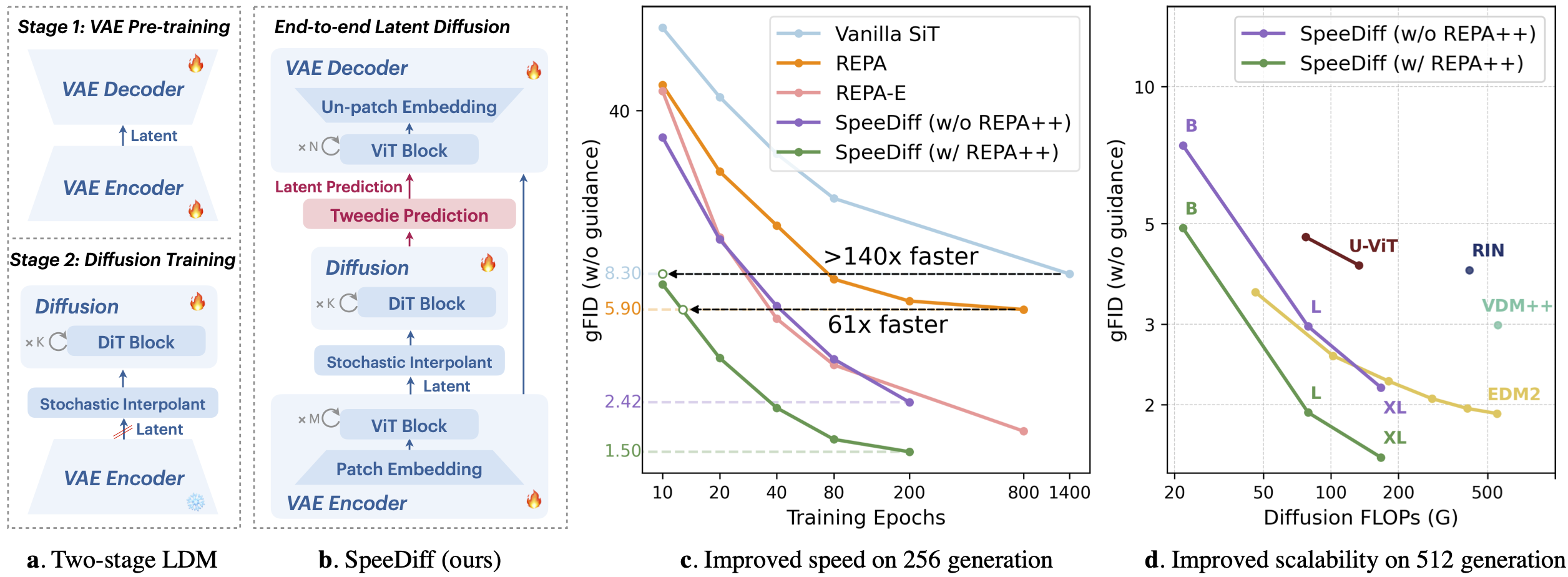
SpeeDiff: Scalable Pixel-Anchored End-to-End Latent Diffusion Model
In Proceedings of the IEEE/CVF Conference on Computer Vision and Pattern Recognition, 2026We present Scalable Pixel-anchored End-to-end Diffusion (SpeeDiff), a latent diffusion method that jointly trains the VAE and the diffusion model from scratch. In principle, joint training allows the diffusion loss gradient to directly guide the VAE encoder, encouraging the formation of a generation-friendly latent space and potentially yielding faster convergence than the conventional two-stage approach with a pretrained frozen VAE. However, a naive end-to-end implementation severely degrades performance, as unrestricted backpropagation of the diffusion loss leads to latent space collapse. Our main technical contribution is a simple yet effective Tweedie Pixel Reconstruction (TPR) loss, which provides additional pixel-level feedback by decoding a predicted clean latent from an intermediate noisy state using Tweedie’s formula, thereby alleviating collapse. Furthermore, our method enables jointly scaling a fully transformer-based architecture and enhances representation alignment within the end-to-end framework. Our SpeeDiff-XL model achieves over 140× and 61× faster training compared to Vanilla SiT and REPA, respectively, while attaining an FID of 1.50 without guidance on ImageNet 256×256 generation. With a more efficient 32× compressed VAE, our model further reaches an FID of 1.53 without guidance on ImageNet 512×512 generation.
@inproceedings{zhang2026speediff,
  title = {SpeeDiff: Scalable Pixel-Anchored End-to-End Latent Diffusion Model},
  author = {Zhang, Bingliang and Chu, Wenda and Li, Yizhuo and Yang, Linjie and Yue, Yisong and Bouman, Katherine L. and Song, Yang and Guo, Qiushan},
  booktitle = {Proceedings of the IEEE/CVF Conference on Computer Vision and Pattern Recognition},
  pages = {35893--35903},
  year = {2026},
}
- CVPR Oral
Improving diffusion inverse problem solving with decoupled noise annealing
In Proceedings of the Computer Vision and Pattern Recognition Conference, 2025Diffusion models have recently achieved success in solving Bayesian inverse problems with learned data priors. Current methods build on top of the diffusion sampling process, where each denoising step makes small modifications to samples from the previous step. However, this process struggles to correct errors from earlier sampling steps, leading to worse performance in complicated nonlinear inverse problems, such as phase retrieval. To address this challenge, we propose a new method called Decoupled Annealing Posterior Sampling (DAPS) that relies on a novel noise annealing process. Specifically, we decouple consecutive steps in a diffusion sampling trajectory, allowing them to vary considerably from one another while ensuring their time-marginals anneal to the true posterior as we reduce noise levels. This approach enables the exploration of a larger solution space, improving the success rate for accurate reconstructions. We demonstrate that DAPS significantly improves sample quality and stability across multiple image restoration tasks, particularly in complicated nonlinear inverse problems.
@inproceedings{zhang2025improving,
  title = {Improving diffusion inverse problem solving with decoupled noise annealing},
  author = {Zhang*, Bingliang and Chu*, Wenda and Berner, Julius and Meng, Chenlin and Anandkumar, Anima and Song, Yang},
  booktitle = {Proceedings of the Computer Vision and Pattern Recognition Conference},
  pages = {20895--20905},
  year = {2025},
}
- TMLR
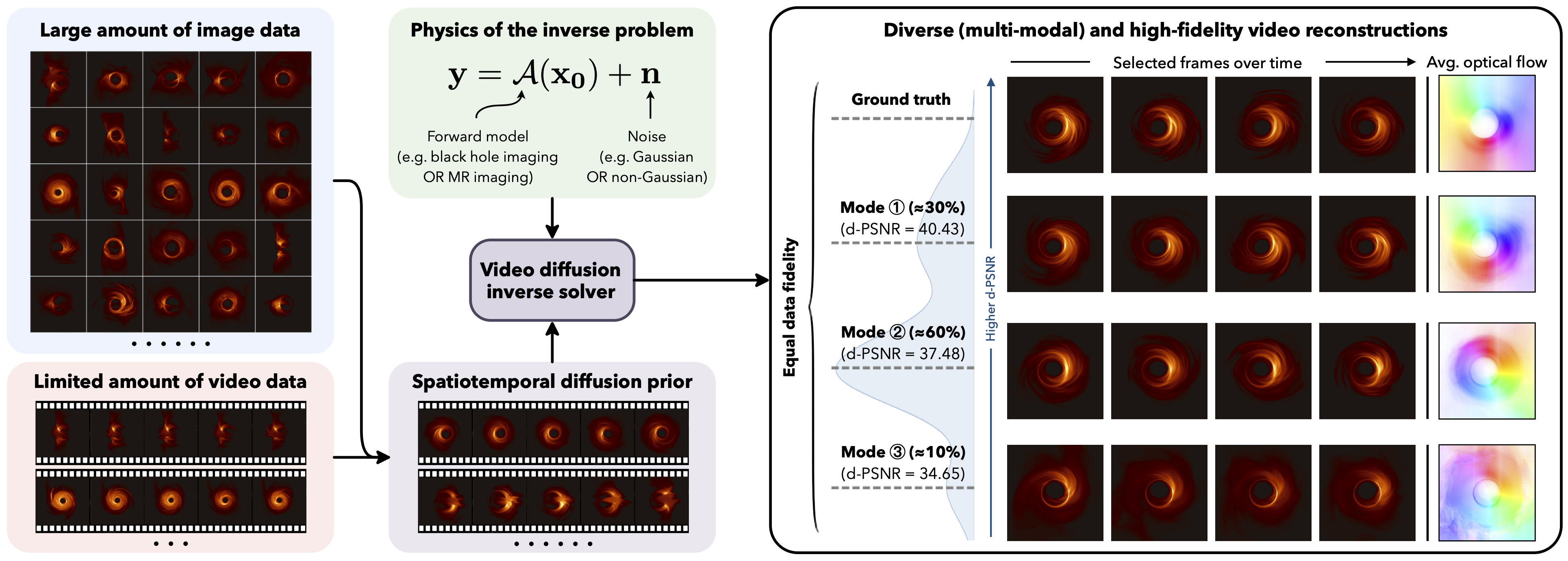
STeP: Solving Scientific Video Inverse Problems with Spatiotemporal Diffusion Priors
Transactions on Machine Learning ResearchReconstructing spatially and temporally coherent videos from time-varying measurements is a fundamental challenge in many scientific domains. A major difficulty arises from the sparsity of measurements, which hinders accurate recovery of temporal dynamics. Existing image diffusion-based methods rely on extracting temporal consistency directly from measurements, limiting their effectiveness on scientific tasks with high spatiotemporal uncertainty. We address this difficulty by proposing a plug-and-play framework that incorporates a learned spatiotemporal diffusion prior. Due to its plug-and-play nature, our framework can be flexibly applied to different video inverse problems without the need for task-specific design and temporal heuristics. We further demonstrate that a spatiotemporal diffusion model can be trained efficiently with limited video data. We validate our approach on two challenging scientific video reconstruction tasks: black hole video reconstruction and dynamic MRI. While baseline methods struggle to provide temporally coherent reconstructions, our approach achieves significantly improved recovery of the spatiotemporal structure of the underlying ground truth videos.


News
All news-
Attending NeurIPS 2025 at San Diego from 12.1 to 12.7. Happy to chat and connect!
-
Internship in ByteDance Seed vision team at San Jose.
-
Presenting our DAPS paper (oral) at CVPR 2025 in Nashville, please join our talk and poster session.